
“I don’t believe that your creativity comes from something outside of you, that you must be visited by Terpsichore before you can dance, or by Clio before you can write history. You’re writing the tragedy, not Melpomene. You’re studying astronomy, not Urania. It’s like what I just said about God. God gives you buoyancy; but I do the swimming. […] I think about the muses the same way I think about my Parkinson’s. It may be changing the chemistry and the electrical wiring in my brain. But I’m still me. It’s me. It IS me. I’m still the writer. It’s my creativity. It’s MY creativity. The muse, if there are muses, creates the conditions that enables me to write. Parkinson’s Disease is a muse. The tenth muse. MY tenth muse.”
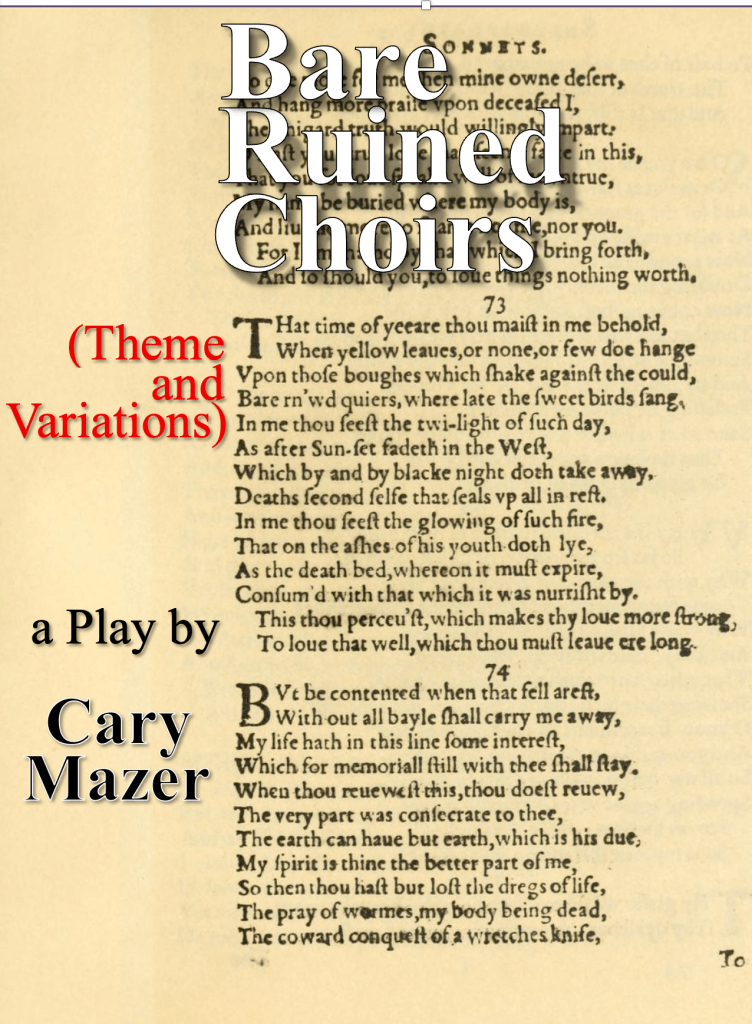
1 f, 1 m (preferably with a neuro-motor disability, which may necessitate adding a silent male actor as Cameron’s double in certain scenes.
ABOUT THE PLAY:
Cameron has Parkinson’s disease, and is beginning to worry about how his ailment might affect his creativity, his mobility, his retirement travel plans, and above all, his marriage. Alice is beginning to worry about the role in which she has been cast, as her husband’s “care partner.” Both Alice and Cameron are afraid that they might lose one another as they struggle not lose themselves. Whatever answers they find, they find in examining Shakespeare’s sonnet #73.
Download the latest version of the script at: 
or contact the playwright directly.
Direct all inquiries about performance rights to the playwright.
 Cary Mazer